Some cafés are built to serve coffee. Others are built to serve something larger: dignity, connection, opportunity, and a new way of seeing one another. Our café firmly belongs in that second category.
The proposed social café is designed as a welcoming public space where people with and without blindness can meet naturally through everyday experience. Rather than positioning accessibility as a separate issue or a special accommodation, the café makes inclusion part of ordinary life: sitting together, sharing food, attending cultural evenings, hearing music, meeting neighbors, and being served by people whose talents are too often underestimated.
At the heart of the project is a simple but powerful idea: meaningful employment changes more than a résumé. It changes confidence. It changes public perception. It changes the relationship between a community and the people it has too often failed to fully include.
The café builds on existing experience in educational kitchens, rehabilitation, home economics, and café operations. That foundation matters. This is not just a feel-good concept; it is a practical model rooted in training, hospitality, and real work. The goal is to create meaningful employment, positive everyday encounters, and a platform for cultural events and emerging artists.
The location makes the opportunity even stronger. Positioned at a strategic junction between two central train stations, the café has the potential to become more than a destination. It can become part of people’s daily rhythm: a stop on the way to work, a place to meet after a commute, a courtyard for an evening event, or a quiet reminder that public spaces are strongest when they are shared by everyone.
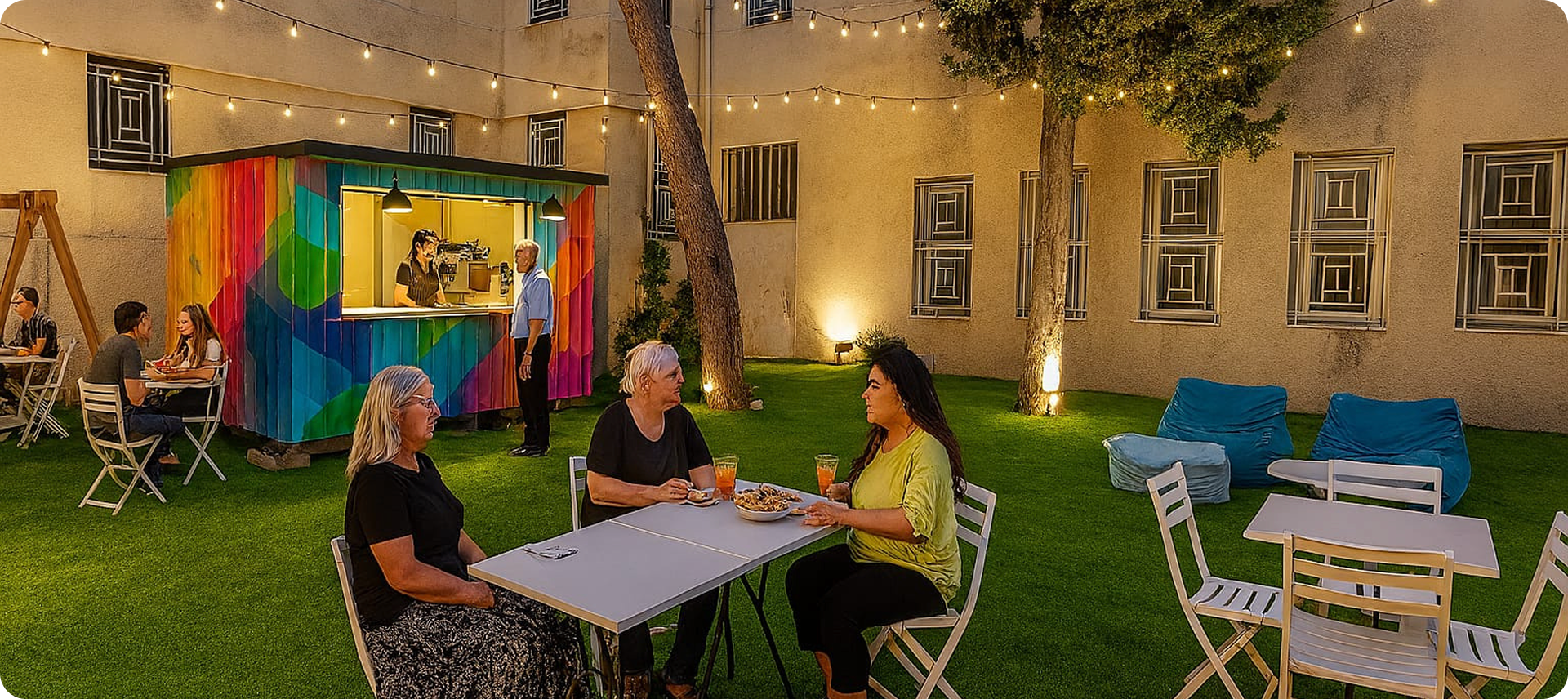
The physical vision is approachable and warm. It is modest in structure but ambitious in impact. The design invites people in without over-explaining itself. Visitors may come first for coffee, food, music, or atmosphere — and leave with a changed understanding of what inclusion can look like when it is embedded into daily life.
That is the strength of our café. It does not ask people to attend a lecture about stigma. It lets them experience the opposite of stigma directly.
A good café creates comfort. A great café creates community. We believe ours has the potential to do both while offering respectful employment, cultural programming, and a living example of social empowerment in action.
In a world where accessibility is too often treated as an obligation, we reframe it as an invitation: come sit, eat, listen, talk, and meet people as they are. That is how consciousness changes — not all at once, but through small, repeated moments of human contact.And sometimes, that begins with a cup of coffee.